Archive

Tag Archives: Terrorism

Nicholas Brock, who lived with his mother, had framed ‘certificate of recognition’ from KKK under his bed
A neo-Nazi who posed for a photo while wearing a Make America Great Again hat has been convicted of terror offences.

Nicholas Brock, 53, was found guilty of three counts of possessing documents useful to a terrorist on Tuesday.

He denied the charges and said he was a “military collector”, who had an interest in weapons and ammunition stemming from his love of Action Man figures as a child.

But a jury convicted him for possessing The Anarchists’ Cookbook version 2000, which contains bomb recipes, a document on knife fighting techniques and a US military manual containing further instruction on fatal attacks.

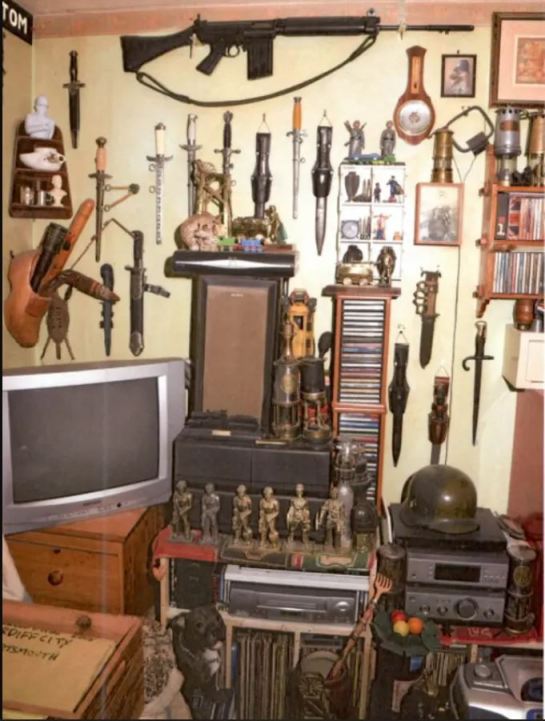
Kingston Crown Court heard that he had an “extreme right-wing mindset” and possessed Nazi weapons, memorabilia and literature.

Brock, who lived with his mother in Maidenhead, has tattoos of “prominent German Nazi figures from the 1930s and 40s”, an SS Totenkopf skull, runes and other symbols adopted by neo-Nazis and white supremacists.

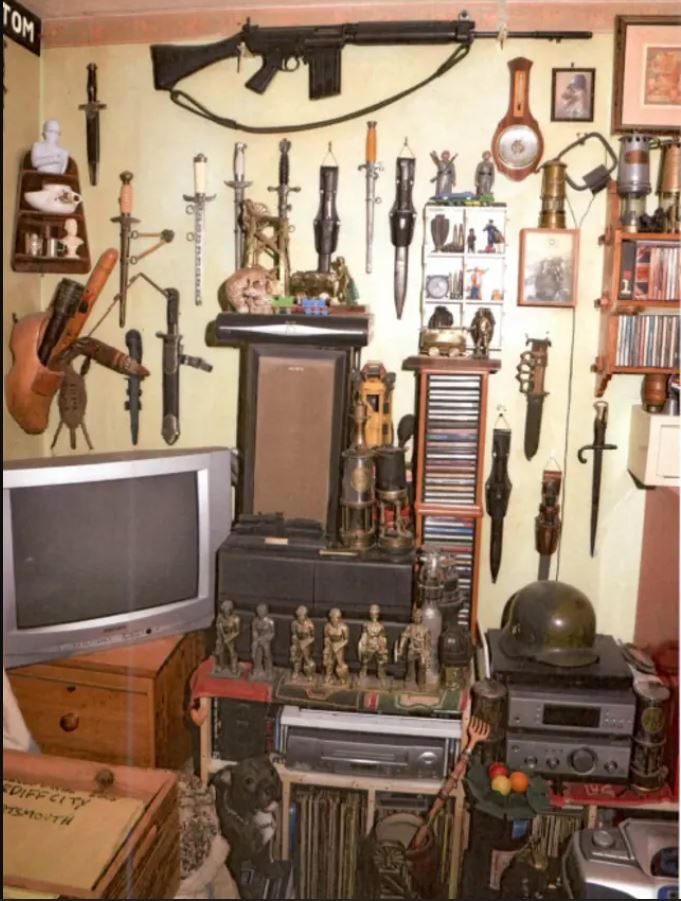
He possessed a collection of Second World War knives and daggers bearing Nazi and SS insignia, and recipes for homemade bombs annotated with hand-drawn swastikas.

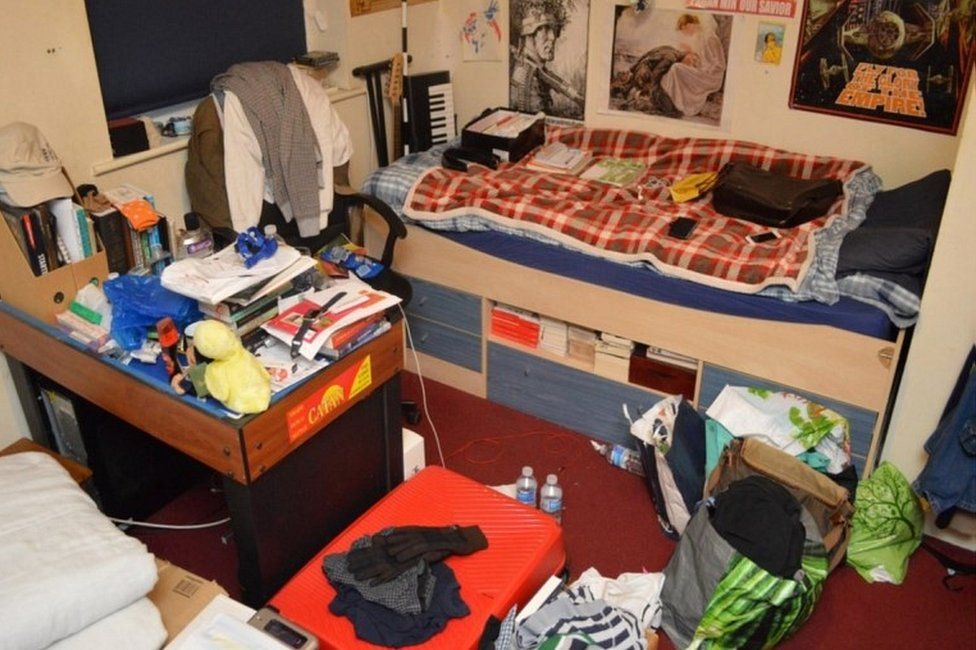
Police also found a framed “certificate of recognition” from the Ku Klux Klan (KKK), in the defendant’s name, under his bed.

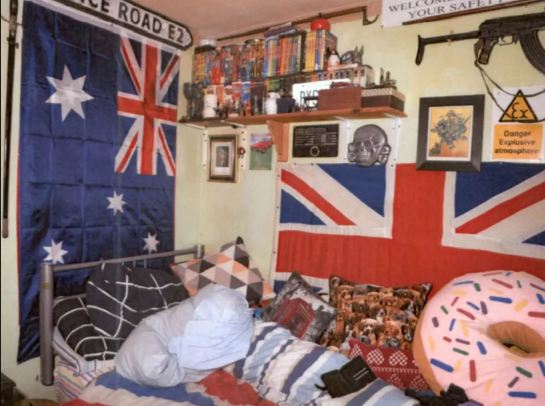
Prosecutor Emma Gargitter said seized electronic devices contained photos showing a man believed to be Brock posing in his bedroom, while wearing a balaclava and holding “a large firearm”, and posing in front of a swastika flag.

She told the court there was also “a photograph of the defendant wearing a ‘Make America Great Again’ cap, in front of the Confederate flag”.

The slogan, often abbreviated as “Maga”, was used by Donald Trump during his successful 2016 US presidential campaign.

The former president popularised the wearing of distinctive red baseball caps emblazoned with the phrase in white letters, of the kind Brock was wearing.

He was standing in front of the battle flag of the defeated Confederate States of America, which has been appropriated by white supremacist groups.

Police found literature including a copy of Adolf Hitler’s book Mein Kampf, National Front flyers in an envelope addressed to Brock and books about the KKK and neo-Nazi group Combat 18.

A flag displaying an eagle and swastika were on Brock’s bedroom wall, and he had an SS wall plaque, Nazi propaganda poster and Nazi badge on his bedside table, the court heard.
Jurors were told that his laptop, hard drives and mobile phones contained insignia, flags and other material associated with historical and contemporary far-right groups, and videos of “extreme violence”.

They included the footage taken by the 2019 Christchurch mosque shooter, beheadings and KKK cross burnings.

Searches had been made on Brock’s laptop for banned neo-Nazi terrorist group National Action, as well as for other extremist groups and racist terms.

“Analysis conducted across all of Mr Brock’s electronic devices, and indeed a spin around his bedroom revealed that one of Mr Brock’s interests was in everything Nazi,” Ms Gargitter said.

The former president popularised the wearing of distinctive red baseball caps emblazoned with the phrase in white letters, of the kind Brock was wearing.

He was standing in front of the battle flag of the defeated Confederate States of America, which has been appropriated by white supremacist groups.

Police found literature including a copy of Adolf Hitler’s book Mein Kampf, National Front flyers in an envelope addressed to Brock and books about the KKK and neo-Nazi group Combat 18.

A flag displaying an eagle and swastika were on Brock’s bedroom wall, and he had an SS wall plaque, Nazi propaganda poster and Nazi badge on his bedside table, the court heard.

Jurors were told that his laptop, hard drives and mobile phones contained insignia, flags and other material associated with historical and contemporary far-right groups, and videos of “extreme violence”.

They included the footage taken by the 2019 Christchurch mosque shooter, beheadings and KKK cross burnings.

Searches had been made on Brock’s laptop for banned neo-Nazi terrorist group National Action, as well as for other extremist groups and racist terms.

“Analysis conducted across all of Mr Brock’s electronic devices, and indeed a spin around his bedroom revealed that one of Mr Brock’s interests was in everything Nazi,” Ms Gargitter said.

“These are not ‘everyday’ items or collectable memorabilia, but publications which contain detailed advice on how to create explosives and explosive devices – bombs, on how to kill and how to maim,” she told the jury.

“They may of course be of use to someone planning any kind of violent attack; and they would certainly be of use to someone planning a terrorist attack.”

Edward Butler, defending, told the jury that Brock was not a terrorist and was not planning to commit a terror attack.

“Some of the material we have viewed and the allegations against Mr Brock are unpleasant and appalling,” he added. ”You may well think that this is not the kind of man you’d want to go for a pint with, or that he spends far too much time on his computer.”

Detective Chief Superintendent Kath Barnes, head of Counter-Terrorism Policing South East, said the material Brock possessed “went far beyond the legitimate actions of a military collector”.

“Brock showed a clear right wing ideology with the evidence seized from his possessions during the investigation,” she added.

“In this case, Brock has been found in possession of very dangerous and concerning material and will face the full consequences of this by the courts.

“We are committed to tackling all forms of toxic ideology which has the potential to threaten public safety and security.”

Brock will be sentenced on 25 May and the Recorder of Richmond, Judge Peter Lodder QC, remanded him into custody ahead of that date.

The Independent
Emil Apreda also threatened to bomb Black Lives Matter protesters and MPs if £10m not paid, investigators say

A man who posed as a neo-Nazi has been jailed for threatening to bomb an NHS hospital at the height of the coronavirus pandemic.

Emil Apreda, a 33-year-old Italian man living in Berlin, threatened to place an explosive device in an unspecified English hospital unless he was paid £10m in Bitcoin.

His message purported to be from the neo-Nazi group Combat 18, but investigators said he used it as a “front for his extortion” and that he did not have access to a bomb.

Apreda emailed his threat to the NHS on 25 April 2020, but sent the same message to the National Crime Agency (NCA) control centre hours later.

Officials said they did not publicise the incident over fears that people would not seek hospital treatment because of safety concerns, and that Covid patients on ventilators would die if evacuated.

Tim Court, the head of investigations in the NCA’s cyber crime unit, said the threats were not known outside a “very tight circle” of people, including senior counter-terror police officers.

“Any loss of life was not acceptable to us – a lot was done, not a lot was known,” he said.

“This was one of the most significant threats we’ve seen in quite some time to UK infrastructure. At the height of this we were losing nearly 1,000 [Covid victims] a day and for six weeks we were trying to manage somebody who could have been planting a bomb in a hospital somewhere in the UK.”

Mr Court said concern about a potential bomb was heightened by the increased use of oxygen inside hospitals. Potential targets were “hardened” in response to the threat, he added.

Nigel Leary, who led the NCA operation, said the threat then evolved over the following weeks.

“Our offender paid close attention to other world events that were going on at the time to try to increase our perception of that threat and elicit the response they were after,” he told a press conference.

“After the death of George Floyd, they changed the modus operandi and threatened to place a bomb at a protest in support of the Black Lives Matter campaign.”

Then ahead of the anniversary of the assassination of Labour MP Jo Cox, who was killed by a neo-Nazi in June 2016, Apreda started threatening MPs.

On Friday, he was convicted of attempted extortion following a trial that started in December at Berlin’s Tiergarten District Court and jailed for three years.

Apreda was released on bail until the ruling is ratified, because under German law the verdict is not immediately binding and can be appealed within a week.

Investigators said Apreda, who previously worked in computing and privacy, was “confident” that he could hide his identity by using the dark web, encryption and other tools.

But analysis, including behavioural and linguistic science, narrowed down his location to several potential countries, whose investigative services were contacted, and Apreda was identified.

Armed police raided his Berlin flat and arrested him on 15 June, seizing electronic devices used for the scheme.

The NCA said that although Apreda was an Italian national, he was born in Berlin and there was “no realistic” prospect of him being extradited to the UK for trial.

The agency shared its material with German authorities, who also carried out their own investigation.

Mr Court said the investigation had not uncovered a link to the UK and that the NHS was believed to have been targeted because of its vulnerability at the time, rather than because Apreda had “an axe to grind”.

He said there was also no evidence of a true affinity with the far right, and the NCA believed the ideology was used in communications as an “attempt to utilise and leverage the fear that would engender”.

“This was serious crime, attempted extortion and using social engineering to make the risk seem more significant to try to get the response he wanted,” Mr Court added.

But he said that if the case had been tried in the UK, Apreda may have been charged with terror offences because of the nature and effect of his threats.

Lisa Jani, a spokesperson for the Berlin criminal courts, said British authorities appeared via video-link to give evidence at the trial and confirmed that no payment was made.

She said Apreda had been freed on bail and must report to police twice a week until the judgment is finalised.

An NHS spokesperson said: “The threat made during the extortion demand significantly added to the pressures on the NHS during the covid pandemic and meant senior leaders and emergency response staff were called on to direct the NHS aspects of the response to this threat.

“The threat and demand was made at a time that hospitals were at their most vulnerable, and could have resulted in significant loss of life.”

The Independent

A boy from Cornwall is the youngest person in the UK to commit a terrorism offence. The teenager pleaded guilty to 12 offences and was given a two-year youth rehabilitation order instead.

His actions, carried out from his home in the South West, invite two immediate questions.

How and why?

The how is relatively easy to answer. He downloaded a bomb-making guide, while aged only 13, the first of many such documents he would own or share with others.

The why is more complicated.

He was active in online neo-Nazi networks – spaces where he could mask his age and real identity.

In this way, he was able to lead and recruit others.

After first joining extremist forums in 2018, the teenager followed the digital signposts into more private chat groups occupied by people from around the world.

Within months, he was creating the UK version of a neo-Nazi group called Feuerkrieg Division, which – unknown to him – was led by an even younger boy from Estonia.

FKD, since banned as a terrorist organisation in the UK, is one of several similar groups to first emerge online.

The neo-Nazi ideology promoted by FKD is at the furthest end of the extreme right.

It mocks far right organisations which engage in democratic politics or rallies, saying instead the only way forward is to trigger a race war and societal collapse through terrorist violence.

To this end, it glorifies various killers responsible for racist mass murder and provides practical instructions to its members, such as information on how to make and use weapons.

In court, the boy’s lawyers said he was home-schooled by his grandmother, socially isolated, and emotionally undeveloped after experiencing a “simply dreadful childhood” which resulted in him having no contact with his parents.

But, online, rather than seeming passive and lacking in confidence, he was assertive and confident enough to command others.

As a recruiter for FKD, he would send prospective members a list of questions and then vet them for suitability – he recruited five people in this way, although one was an undercover police officer.

He was more at home online than he was in the real world.

However, there is not a binary division between the internet and normal life.

A series of extreme right-wing terror attacks have been spawned online and carried out with an online audience watching, including the Christchurch attack in New Zealand that killed 51 Muslim worshippers.

FKD, despite having such young leading figures, has generated a series of prosecutions around the world involving older people.

  • A Lithuanian member jailed for attempting to detonate explosives in the capital city.
  • In Germany a member convicted of planning violence that posed a threat to the state.

In the UK, a teenager from Rugby called Paul Dunleavy – who was recruited by the Cornish boy – was jailed last year for planning a terrorist attack.

The very nature of these quickly constructed organisations, which employ encrypted apps to communicate and recruit, allows such disparate individuals to come together.

This danger comes from having such groups of people encouraging one other’s worst tendencies.

‘Extreme hatred’

Indeed, the culture of groups like FKD is to make people feel guilty and worthless if they do not act on their violent beliefs.

The Cornish boy, for example, praised the Christchurch attacker.

He encouraged members to be “active” and said that “failure of activity will result in expulsion”.

He continuously posted violent and hateful material. One document stated that “every resistance group uses assassination (murder) and torture (rape) as weapons against the agents of the State”.

Following the boy’s sentencing at the Old Bailey, Ch Supt Jim Pearce, from Devon and Cornwall Police, said: “The young age of the offender combined with the extreme hatred displayed and the quick progression of his role within the worldwide extremist group brings into sharp focus the real and clear danger of online radicalisation.”

BBC News

Boy from Cornwall whose offending began at 13 and who founded UK branch of FKD will be sentenced next week

The teenage leader of a neo-Nazi group has been convicted over offending that began at the age of 13, making him the youngest person in the UK known to have committed a terrorist offence.

The boy, from Cornwall, who cannot be identified, appeared before the Old Bailey in London via video link on Monday and admitted 12 offences – two of dissemination of terrorist documents and 10 of possession of terrorist material.

At 13 he downloaded a bombmaking manual and began gathering terrorist material. Later in the same year he joined the neo-Nazi cult Fascist Forge, and at 14 he went on to share far-right extremist ideology in online chatrooms.

The court heard that the youth, now 16, led the British branch of the now banned neo-Nazi terrorist organisation Feuerkrieg Division (FKD). The group idolises mass murderers such as those who carried out far-right terrorist attacks in Norway, the US and New Zealand in recent years. FKD encourages so-called “lone wolf” attacks.

Between October 2018 and July 2019, the boy collected a significant amount of far-right material and was active on online platforms, expressing racist, homophobic and antisemitic views. He talked about gassing Jewish people, hanging gay people and wanting to “shoot up their parades”, the court heard.

Naomi Parsons, prosecuting, said police searched the property where the boy lived with his grandmother following reports that he was constructing a weapon. No weapon was found but officers discovered a Nazi flag and well-known Nazi slogan on the garden shed, as well as several manuals about making weapons and instructions on how to kill people on his phone and computer.

“The age is the alarming factor and his conduct betrays a maturity beyond his chronological age,” Parsons said.

In a police interview, the defendant said he had made racist, homophobic and antisemitic comments “to look cool”.

It was claimed that he was in touch with a 14-year-old Estonian boy who founded the FKD and was responsible for vetting and recruiting members and propaganda. They used encrypted messages to discuss their hatred of particular groups.

The defendant then set up FKD GB and recruited five British members from online platforms, including Paul Dunleavy, 17, from Rugby, who was jailed last year for preparing acts of terrorism.

The cell wanted to enact “white jihad” and the genocide of people who were not white, the court heard.

In mitigation, Deni Matthews said the defendant had a “simply dreadful childhood”, and everything he did was in order to “seek approval” from others online.

The judge Mark Dennis said he would need to consider whether the teenager had been immature or naive before passing sentence. He said: “I need to assess a person of this age who sends these messages, [and] whether this is true beliefs or the product of firstly grooming but then self-aggrandisement and the other matters.”

The boy was granted bail subject to strict conditions including residing at his home and attending youth offending services, along with a ban on using computers without police permission and bans on using any private browsing mode, encryption software or virtual storage devices such as the cloud.

The boy will be sentenced on 8 February.
The Guardian

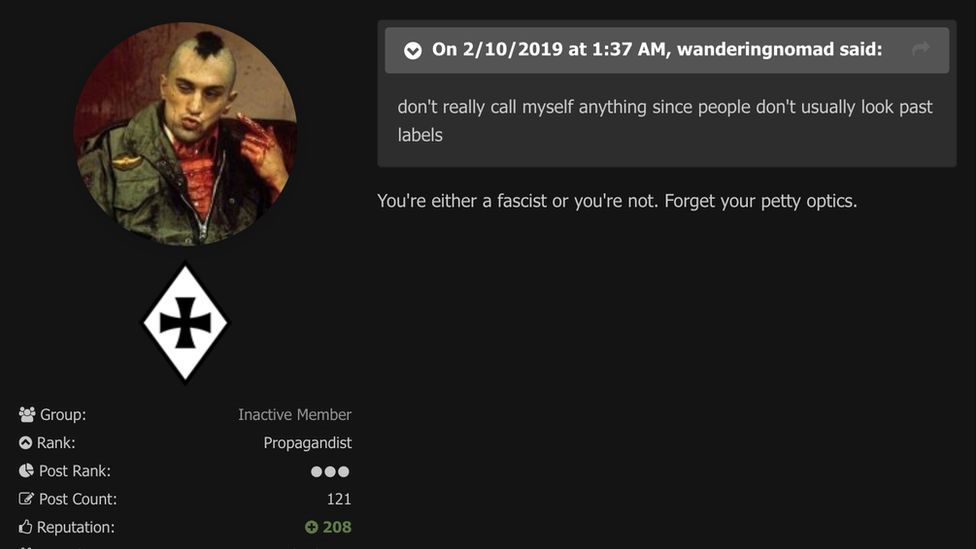
Jack Reed used an alias on a notorious neo-Nazi internet forum

The youngest person to be convicted of planning a terrorist attack in the UK can be named after a bid to keep his identity secret was rejected.
01
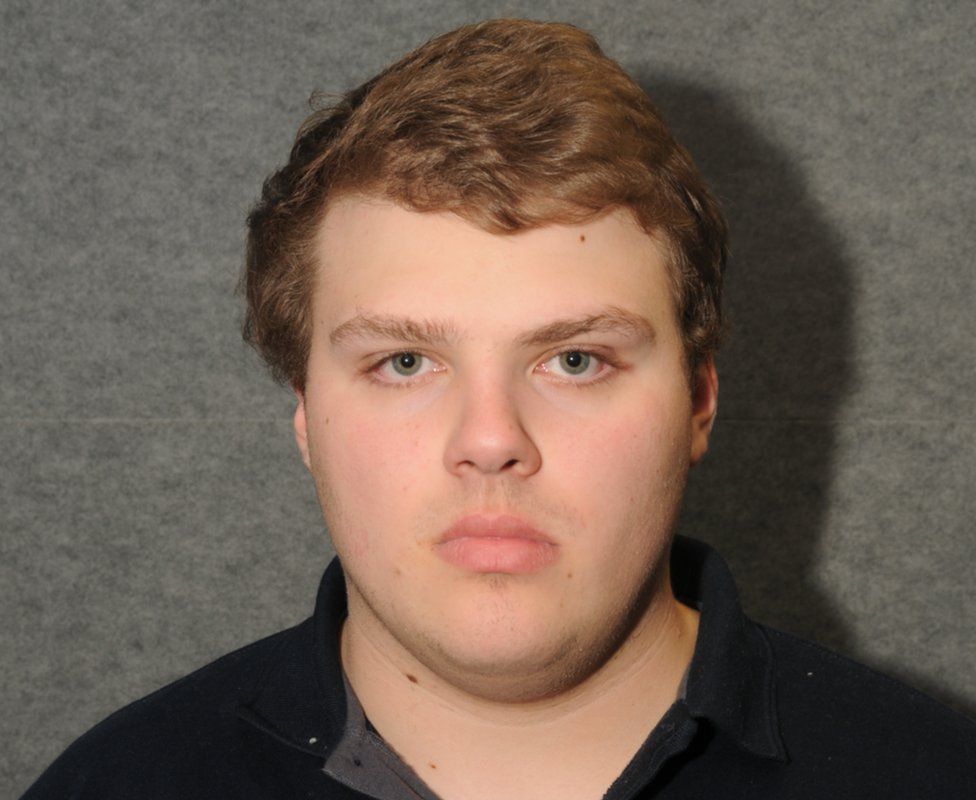
Jack Reed, from New Brancepeth, County Durham, was convicted in November 2019 of six neo-Nazi terror offences.

Last month, two days before his 18th birthday, he applied to retain his anonymity.

But a judge at Manchester Crown Court has now ruled he had no power to make such an order.

‘Natural sadist’

Reed is currently serving a sentence of six years and eight months for the terrorism offences.

At Leeds Youth Court in December he was given another custodial term for unrelated child sexual offences, namely five sexual assaults against a girl.

Reed’s terrorism trial heard he was interested in “occult neo-Nazism” and had described himself as a “natural sadist”.

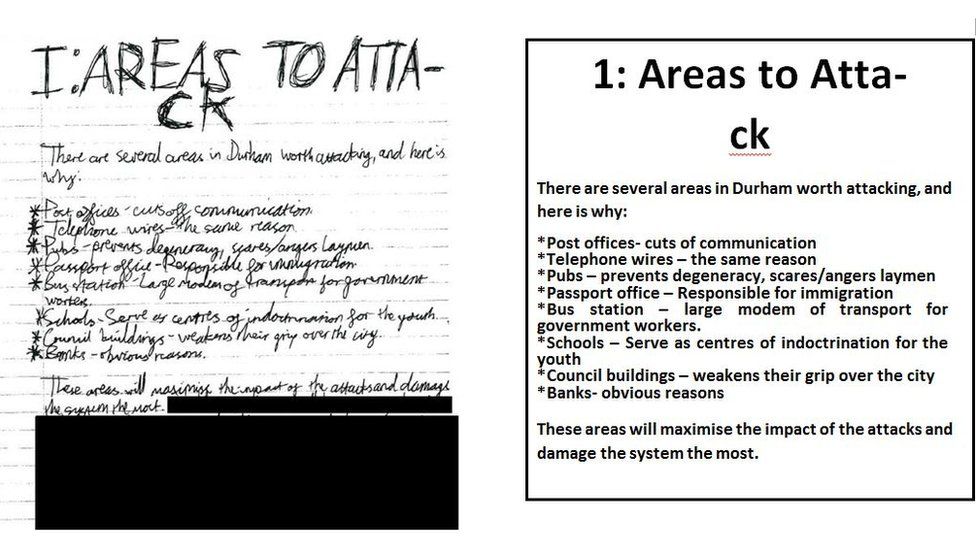
His preparations for an attack in Durham included researching explosives, listing potential targets and trying to obtain a bomb-making chemical.

Last year BBC Panorama identified the website’s founder and another young member who had agreed to provide Reed with the chemical ammonium nitrate.

Reed had persistently searched online in relation to rape and paedophilia and had written about wanting to commit sexual violence.

Jack Reed drew up a “hit list” of areas he wanted to attack in Durham

Reed’s anonymity was set to expire on his 18th birthday but the day before, 23 December, Judge Nicholas Dean QC granted an interim anonymity order after his legal team applied to extend the reporting restrictions.

Following submissions from the media, the judge ruled that the Crown Court has “no power.. to make the order sought”.

He said that such a power does exist in the High Court, but Reed’s barrister confirmed there was no intention to make an application there.

The power has only previously been used in five criminal cases.

In 2016 two brothers who had tortured other children in South Yorkshire were granted lifelong anonymity.

In 2019, a teenage boy from Blackburn who had admitted inciting a terrorist attack in Australia was allowed to remain anonymous.

Lifelong anonymity under new identities has also been granted after release to Mary Bell, the Newcastle child killer; Maxine Carr, who obstructed police investigating the 2002 Soham murders by her partner Ian Huntley; and Jon Venables and Robert Thompson, who murdered Liverpool toddler James Bulger.

BBC News

A one-man neo-Nazi “propaganda machine” who encouraged racist mass murder has been jailed for a string of terror offences.

Luke Hunter, 23, from Newcastle, created extremist material and ran accounts on multiple online platforms.

Hunter, the son of a former counter-terrorism officer, was arrested in 2019 at his home address.

He was affiliated with a now-banned terrorist organisation called the Feuerkrieg Division (FKD).

Hunter, of High Callerton, was sentenced at Leeds Crown Court to four years and two months in prison.

Hiding behind an alias, he posted extremist material to several online platforms, including his own website, podcast, and a channel on the Telegram messaging application.

He used the accounts to promote racial hatred and murder, telling followers that the “eradication” of Jewish people was a “moral and racial duty”.

Death threat film

On the Telegram channel, which had more than 1,000 subscribers, he posted violent neo-Nazi imagery and glorified various terrorists, including the London nail bomber and the man who murdered 51 Muslim worshippers in Christchurch, New Zealand.

The channel was affiliated with FKD, which was banned in the UK as a terrorist organisation earlier this year.

Hunter, who communicated with the group’s young leader, produced video propaganda for FKD, with one film including death threats to the chief constable of the West Midlands. The force had charged an FKD member with planning a terrorist attack.

One of Hunter’s podcast guests was Alex Davies, co-founder of the banned extreme right-wing group National Action.

But Hunter was not only active online and travelled to Glasgow to deliver a speech at a far-right conference.

In October last year detectives searching the house where he lived with his mother found a large hunting knife and a life-size dummy covered in stab marks, prosecutors said.

‘Promoted killing techniques’

A preliminary court hearing heard Hunter’s father, with whom he did not live at the time of his arrest, spent years as a Metropolitan Police counter terrorism officer before transferring to a civilian role.

Hunter pleaded guilty earlier this year to four counts of encouraging terrorism and three of disseminating terrorist publications.

The prosecution argued that Hunter, who has been diagnosed with autism, was “deeply radicalised” and that his activity “smacks of a propaganda machine which has been designed to function over a number of platforms”.

Hunter admitted four counts of encouraging terrorism and three of disseminating terrorist publications

Det Ch Supt Martin Snowden, head of counter terrorism policing north east, said that Hunter’s online activity “glorified terrorism, promoted killing techniques and encouraged the killing of Jews, non-white races and homosexuals.”

He added: “Luke Hunter represents a threat to our society, not simply because of his mindset, but because of the considerable lengths he was prepared to go to in order to recruit and enable others in support of his cause”.

BBC News

Boy, 17, convicted of five sexual assaults against a younger girl

One of the sketches made by the teenager
(Counter Terrorism Policing North East)

A teenage neo-Nazi who was jailed for planning terror attacks has been given a new sentence for child sex offences.

The 17-year-old boy, who cannot be named for legal reasons, was found guilty of five counts of sexually touching a girl under the age of 13.

He was given an 18-month detention and training order for the assaults at Leeds Youth Court on Wednesday.

District Judge Richard Kitson said the term could be served concurrently to his previous sentence of six years and eight months for preparing acts of terrorism.

“The offences [against the girl] are wholly different to those that have resulted in your current sentence and, in theory, consecutive sentences would be justified,” he told the defendant. “I think that would be inappropriate in view of the extended sentence which you are currently serving.”

The defendant is due to turn 18 this month, meaning the ban on identifying him would expire automatically, but his lawyers have applied to extend the reporting restriction.

At a separate hearing at Manchester Crown Court on Wednesday, Judge Nicholas Dean QC granted an extension until a hearing where the arguments can be considered in full on 11 January.

The boy had detailed plans to firebomb synagogues and other buildings in the Durham area as part of what he believed was an upcoming “race war”.

Before being arrested, he wrote that his upcoming 12 weeks of study leave would be “showtime”.

He was convicted of six terror offences, including preparing acts of terrorism, disseminating terrorist publications and possessing material for terrorist purposes.

A court heard that he had been “tipped off” by a fellow extremist on the Fascist Forge forum that a police raid was imminent and deleted evidence as a result, but police could not corroborate that claim.

When he was arrested in March 2019, police found a piece of paper in his pocket containing a message in code that said: “Killing is probably easier than your paranoid mind thinks. You’re just not used to it.”

The boy was carrying a drawing of a fellow school pupil being beheaded, because he believed he was gay and deserved “judgement”.

After reading Norway shooter Anders Breivik’s manifesto, he had written his own version entitled: “Storm 88: A manual for practical sensible guerrilla warfare against the k**e [offensive term for a Jewish person] system in Durham city area, sieg hiel.”

It called for lone-wolf terror attacks to fight against a supposed “genocide” of white people and listed proposed attack targets in Durham, including schools, public transport and council buildings.

Writing on the Fascist Forge forum, the teenager claimed a race war was “inevitable”, and called himself an “accelerationist”.

Prosecutors said they had not identified a “particular act or acts” of terrorism that the boy was going to commit, but that he had been preparing for some kind of atrocity since October 2017.

He denied all offences, claiming he had adopted the terrorist persona for “shock value” and did not want to carry out attacks, but was convicted unanimously of all charges in November 2019.

The court heard that the boy had been an “adherent of a right-wing ideology” since the age of 13, and that his views became more extreme as he immersed himself in fascist websites and forums.

By 2017, he was describing himself as a neo-Nazi and operated a since-deleted Twitter account with a handle referring to a British fascist leader.

His racist and homophobic tweets drew the attention of police but when he was interviewed in September that year, he claimed they were posted “for a laugh”.

The teenager initially agreed to take part in the Prevent counter-radicalisation programme but later stopped engaging.

The boy claimed he was not an extremist, but started another Twitter account and continued communicating with contacts, while accessing a “large quantity of extreme right-wing literature” online and in hard copy.

The court heard he had steeped himself in antisemitic conspiracy theories and ranted about Jewish governors at his school, Jewish MPs and the press.

In August 2018, he described himself as a “radical national socialist” and follower of Adolf Hitler, saying he had read Mein Kampf and had a photo of the Nazi leader on his phone.

Prosecutors said the boy obtained and shared terror manuals on making explosives and firearms on the Ironmarch and Fascist Forge online forums, but also drew on jihadi propaganda.

He had searched for Isis execution videos and used al-Qaeda literature, as well as a jihadi guide on making deadly poisons, including ricin.

By November 2018, he had progressed to extreme occult neo-Nazism and voiced support for satanism.

The teenager declared his support for the “siege” ideology, which was started by an American neo-Nazi and advocates the use of terror attacks to trigger a race war.

“Democracy is very much a dead system; political violence therefore, can only help us,” he wrote. “The white race is being silently genocided, the west is dying.”

Sentencing him for the terror offences earlier this year, the previous Recorder of Manchester, Judge David Stockdale QC, found the teenager’s subsequently diagnosed autism spectrum disorder played a part in his offending.

He described the youth as “highly intelligent, widely read, quick-thinking and articulate” but told him that it was “a matter of infinite regret that you pursued at such a young age a twisted and – many would say – a sick ideological path”.

The Independent

Filip Golon Bednarczyk claimed he wanted to make fireworks but judge said explanation was ‘fanciful’

A mocking image of Filip Golon Bednarczyk stood outside a Luton church that was posted on his Facebook page

A far-right extremist has been jailed for possessing explosives and terrorist documents.

Filip Golon Bednarczyk, 26, denied planning an attack or attempting to make a bomb and claimed he was acting on “curiosity borne out of boredom”.

Giving evidence at the Old Bailey on Tuesday, he said he had downloaded numerous terrorist manuals and collected chemicals and components because he wanted to make fireworks.

But a judge said Bednarczyk’s explanations did not “bear scrutiny” and that he was interested in building bombs.

“I find your admitted right-wing sympathies were the motivation for your interest in explosives,” Judge Anthony Leonard QC told him.

“The idea you drew a circular diagram with nails and a detonator because you wanted to create a firework is fanciful … if the instructions had been followed it would have resulted in a working IED.”

Bednarczyk had admitted possessing an explosive substance under suspicious circumstances between May and December last year.

He also pleaded guilty to seven charges of possessing a document likely to be useful to a person committing or preparing an act of terrorism in relation to various titles about homemade explosives and devices.

The judge sentenced him to four years in prison with another year on licence, and handed Bednarczyk a 15-year notification order in which he has to report his personal details to the police.

When entering his guilty pleas, Bednarczyk insisted he did not want to harm anyone and had not attempted to construct a bomb.

He admitted “right-wing sympathies” but denied being a neo-Nazi and said his online research had not focused on particular groups.

An analysis of his electronic devices revealed an interest in firearms, knives and killings as well as extreme right-wing views.

Filip Golon Bednarczyk cutting up a Britain First membership card in a 2017 YouTube video

The Old Bailey heard that he had a copy of the Christchurch attacker’s manifesto, which claimed white people are being “replaced”, and shared memes supporting the terror attack that left 51 people dead.

Bednarczyk had also searched the internet for Nazis, Hitler, the Polish Defence League — an offshoot of the English Defence League — and Britain First.

The Polish national, from Luton, had targeted Muslims, Jews and the gay community in hateful online posts.

In a Facebook post from July 2019, he shared photos of British police officers supporting Pride events and called them “pathetic”, writing: “Death of European culture and values”.

In 2015, Bednarczyk “liked” a meme showing Mecca being destroyed by nuclear weapons, and called for the burqa to be banned.

Another post suggested that “liberal blood will flow in the streets” for the tolerance of Muslims, transgender people, homosexuality, abortion and feminism.

The previous year, he shared an antisemitic meme which originated on 4chan showing world leaders wearing Jewish skullcaps.

On his YouTube channel, which has more than 4,000 subscribers, Bednarczyk uploaded a video of himself cutting up a Britain First membership card in 2017.

He was arrested by detectives from the Metropolitan Police’s counter-terrorism unit on 11 December.

A search of his bedsit led to the discovery of handwritten notes, electrical component parts and a 2kg bag of sulphur powder inside a wardrobe.

Printed bomb-making instructions were found alongside a blank-firing pistol, a soldering iron and USB stick containing documents and images relating to explosives.

Expert analysis of the material was that it included “viable instructions for a range of explosive materials including low explosives, primary high explosives and secondary high explosives” and “viable instructions for a number of types of IED”, prosecutor Dan Pawson-Pounds told the court.

Bednarczyk said he bought potassium nitrate and sulphur over the internet but later tried to return them because he “lost interest” in it.

He said he did not open the sulphur and told the court: “Out of boredom I was thinking about experimenting with the chemicals for a little excitement in the garden.”

The defendant claimed he had forgotten about the items in his wardrobe and had accidentally downloaded terrorist manuals because he was taking documents off the internet “in bulk”.

Judge Leonard said it was not a “coincidence” that Bednarczyk had kept electronic parts that could have been used to make a detonator alongside the ingredients for gunpowder.

The judge said he was previously warned against keeping such material in March 2018, when police confiscated chemicals discovered at Bednarczyk’s home after his partner’s suicide.

Around that time, the defendant confided in a friend that he was concerned about what police would discover if they searched his computer, because he had been looking at how to make a bomb.

The court heard that Bednarczyk, who has a seven-year-old son in Poland, may have exaggerated symptoms of poor mental health during a psychiatric assessment and did not suffer from a condition that affected his culpability.

Defence barrister Beth O’Reilly told the court there was “no evidence of a terrorist connection” in the case, adding: “He describes his interest [in explosives] as curiosity, that interest wasn’t acted on.”

The Independent

Paul Dunleavy was jailed for five years and six months, after a trial at Birmingham Crown Court

A teenager who was part of a banned neo-Nazi group has been jailed for preparing acts of terrorism.

A judge ruled 17-year-old Paul Dunleavy can be named but described his efforts to commit the act as “inept”.

Dunleavy had admitted nine counts of possessing 9 terror manuals and also had videos of the New Zealand terror attack in 2019, in which 51 people died.

At Birmingham Crown Court, Judge Paul Farrer QC jailed the defendant for five years and six months.

Dunleavy, who had denied preparing an attack, had joined a neo-Nazi group called Feuerkrieg Division (FKD) in July last year, the court was told.

The group was created by a 13-year-old Estonian and was outlawed in the UK this summer after being linked to terrorism cases around the world.

Notepads made by the teenager and a gun were recovered from his room

Judge Farrer said Dunleavy had offered practical advice on firearms to other FKD members, some of whom have gone on themselves to be convicted of terrorism offences in other countries.

The judge told the defendant he harboured an intention to commit an act of terrorism, but added it was unlikely the he would have followed through, describing his preparations as “inept”.

He added: “Your autism impacts on your maturity and understanding.”

Dunleavy had an “unhealthy interest in other attacks across the world”, police said

Prosecutors said FKD’s aim was to overthrow the liberal democratic system by bringing about a race war through individuals carrying out acts of mass murder.

After joining FKD’s online chat group, Dunleavy unwittingly began communicating with an undercover police officer, telling him: “I’m getting armed and getting in shape.”

The court was told Dunleavy had researched how to convert a blank-firing gun and asked an adult friend for advice on where to buy one.

Following his arrest at his home in September 2019, West Midlands Police said detectives seized his phone, finding over 90 documents on firearms, explosives and military tactics, right wing material and online chat conversations.

They also found several knives, air rifles, face coverings, camouflage face paint, shotgun cartridges and bullet casings.

Dunleavy had named Adolf Hitler as one of his heroes, West Midlands Police said

“This boy had an unhealthy interest in other attacks across the world and he knew exactly what online platforms to join to share his extreme views,” said Det Ch Supt Kenny Bell, head of West Midlands Counter Terrorism Unit.

“He believed he had the skills to convert a blank firing weapon into a viable firearm and was willing to help others with his abilities.”

BBC News

A high-achieving grammar school pupil who secretly promoted neo-Nazi terrorism online has been sentenced.

Harry Vaughan, 18, from south-west London, had pleaded guilty to 14 terror offences and two of possessing indecent images of children.

Passing sentence at the Old Bailey, Mr Justice Sweeney said: “You are a dangerous offender.”

He sentenced Vaughan to two years detention in a young offenders’ institution, suspended for two years.

The 18-year-old was also ordered to attend a rehabilitation programme.

The judge said Vaughan had lived at home with his family and been an “A* student”, adding none of them knew that from the age of 14 he had been involved with groups on the internet.

Vaughan’s father, who was in court, is a clerk in the House of Lords and his mother is a teacher. Vaughan had been a pupil at Tiffin Grammar School in Kingston upon Thames.

The judge told the teenager neo-Nazi material found during police searches showed “the depth of your extreme right-wing mindset”.

He added that expert evidence stated Vaughan’s ideology was a “hybrid” of neo-Nazism and left-hand path Satanism.

Vaughan was prolific online and hid behind a series of aliases.

He uploaded self-made propaganda images to a neo-Nazi website promoting the now-banned terrorist organisation Sonnenkrieg Division.

He also possessed – and posted online – a series of weapons and explosives manuals.

The 18-year-old previously pleaded guilty to 12 counts of possessing documents useful to a terrorist, one count of encouraging terrorism, and one of disseminating terrorist publications.

He also admitted two counts of possessing indecent images, relating to videos showing young boys being raped.

Commander Richard Smith, head of the Met Police Counter Terrorism Command, said: “What this case tells us is that anybody can be affected, anybody can be radicalised.”

He said Vaughan is a “very intelligent young man” but he “now has convictions for terrorist offences which will stay with him for life and I think that is a saddening case and also a salutary example of how this can affect young people”.

BBC News